
Letter of Recommendation Template
Writing a recommendation letter is easier with a clear structure: who you are, how you know the candidate, two or three strengths backed by specific examples, and a confident closing. Fill in the form and this generator turns your details into a complete, editable letter for a job, graduate programme, college application, scholarship or character reference. Everything stays in your browser.
- Free to use
- No sign-up
- Runs in your browser
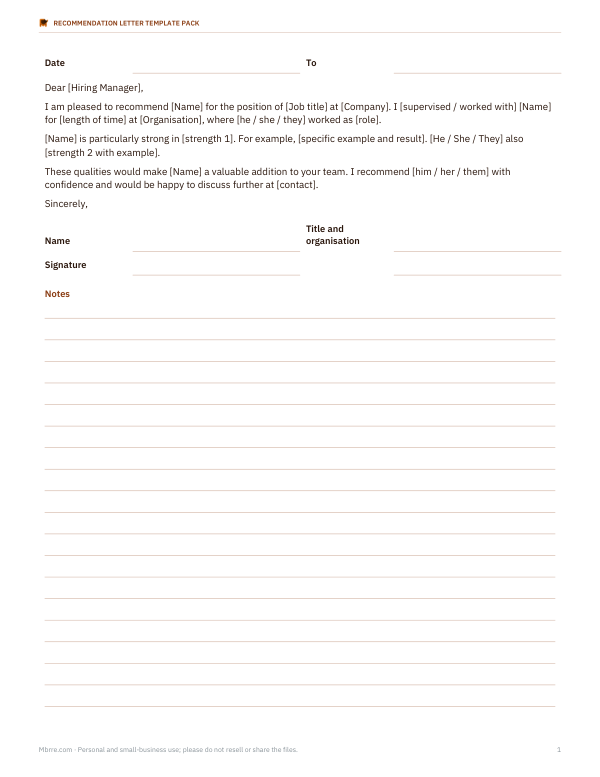
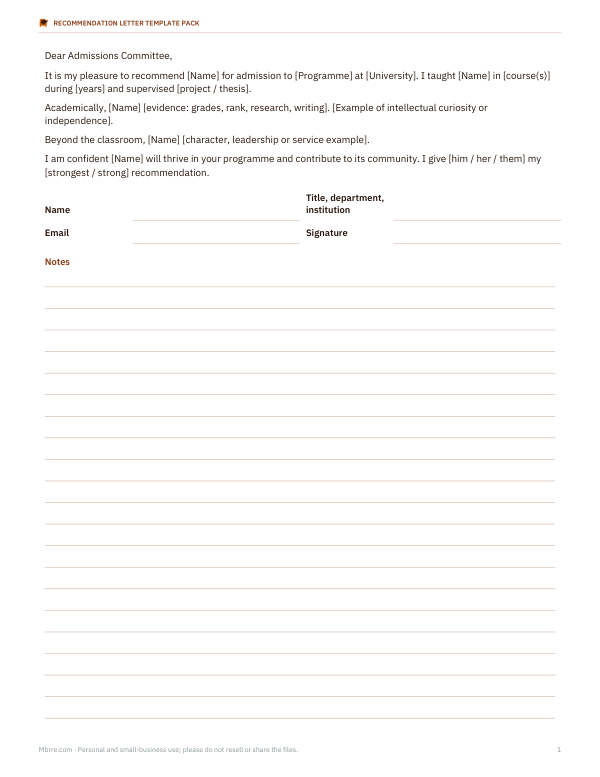
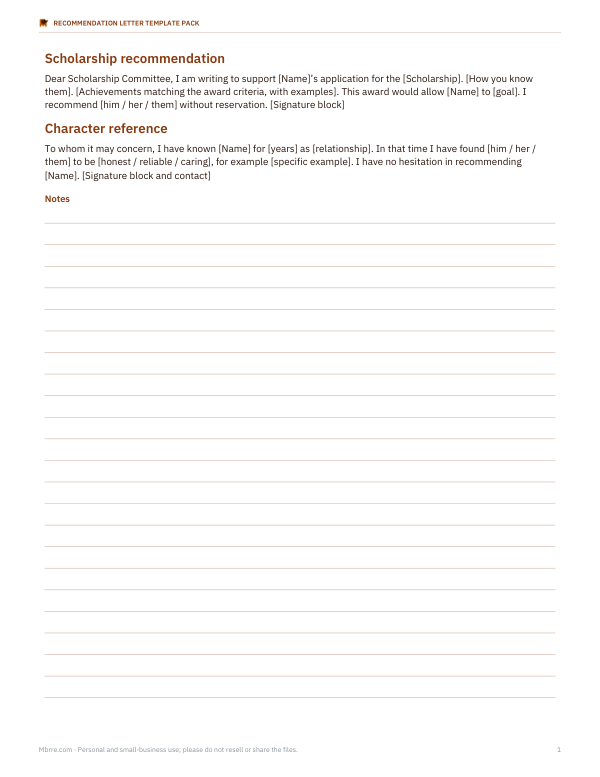
Recommendation letter generator
Recommendation Letter Template Pack
Editable Word templates for job, graduate school, college, scholarship and character recommendation letters, a recommender request form and a writing checklist.
- Job reference (DOCX/PDF)
- Graduate / college (DOCX/PDF)
- Scholarship & character (DOCX/PDF)
- Request form (DOCX/PDF)
- Checklist (PDF/DOCX)
Formats: DOCX, PDF. Instant download after payment (link valid 72 hours, up to 5 downloads). AI-assisted: the templates were drafted with AI help and reviewed and laid out before publishing.
$5.00 USD, one-time 5 files · about $1.00 each
- Instant download
- 7-day refund
- Secure checkout by Stripe
7-day money-back guarantee. Full refund within 7 days of purchase, even after you download.
Free sample: Academic Recommendation Letter (PDF, 59 KB)
Full refund within 7 days — see the refund policy and license.
Free printables
Single sheets you can print right now, no sign-up. The full pack adds every sheet in one download plus the editable files.
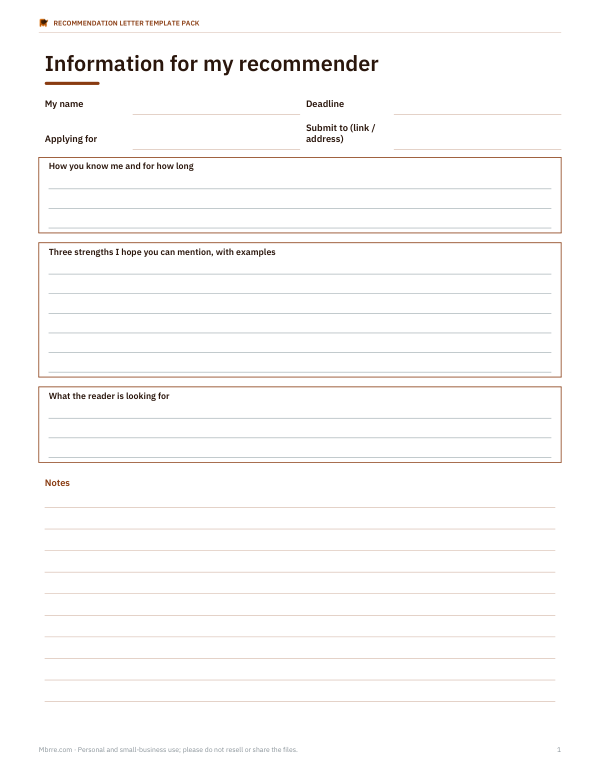 Printable Recommendation Request Form
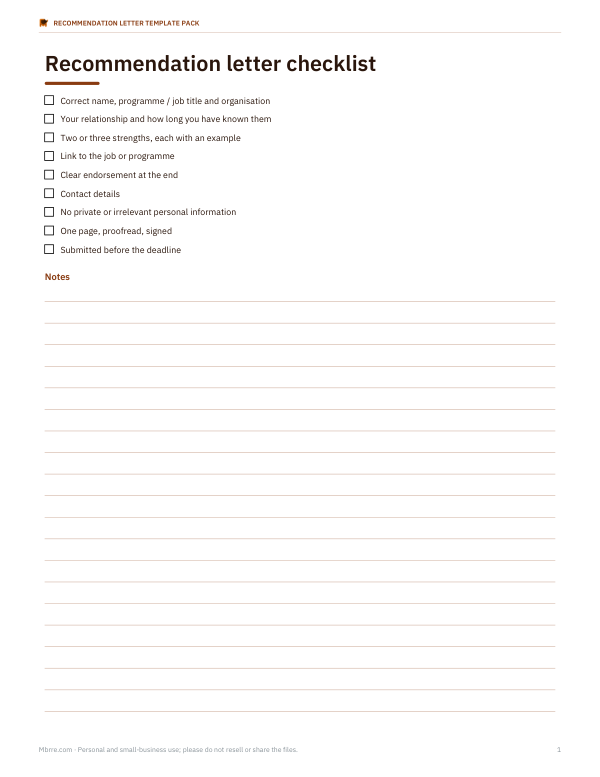 Recommendation Letter Checklist
The structure of a strong recommendation letter
| Part | What to write | Length |
|---|---|---|
| Opening | Who you recommend, for what, and how strongly | 1–2 sentences |
| Relationship | How you know them, in what role and for how long | 1–2 sentences |
| Evidence | Two or three strengths, each with a specific example and result | 1–2 paragraphs |
| Fit | Why those strengths matter for this job or programme | 2–3 sentences |
| Close | A clear endorsement and an offer to be contacted | 1–2 sentences |
Most good letters fit on one page. Admissions committees and hiring managers read many letters, so specific evidence stands out far more than a list of adjectives.
Why specific examples matter
Almost every letter says the candidate is “hard-working” and “a great team player”. What makes a letter credible is proof: a project they led, a problem they solved, a number that improved, a moment that showed their character. Compare “Jordan is a strong communicator” with “Jordan rewrote our customer newsletter and lifted the open rate from 18% to 27% in four months.” The generator asks for an example for every strength for this reason.
Adapting the letter to its purpose
| Purpose | What readers look for |
|---|---|
| Job | Skills, reliability, results and how they work with others |
| Graduate school | Research potential, independence, intellectual curiosity and writing |
| College admission | Academic ability, character, growth and contribution to the school community |
| Scholarship | Achievement, need or merit criteria, and what the award would enable |
| Character reference | Honesty, dependability and how long and how well you know the person |
How to use the generator
- Choose the purpose and enter the job, programme or award.
- Fill in the candidate’s name and pronouns, your relationship and how long you have known them.
- Pick up to three strengths and write a specific example for each.
- Choose how strong your endorsement is — be honest.
- Click Generate, then edit the text freely: add detail, change phrases, make it sound like you.
- Copy it into your letterhead, download it as text, or print it.
Worked example
Suppose you supervised Jordan, a marketing assistant, for three years and are recommending them for a Marketing Coordinator role. A weak letter says Jordan is “hard-working, reliable and a great communicator.” A strong letter opens with a clear endorsement, explains that you managed Jordan for three years, then gives evidence: Jordan rewrote the customer newsletter and lifted its open rate from 18% to 27%; set up a content calendar the whole team now uses; and trained two new assistants. It closes by linking those strengths to the coordinator job and offering to take a call. The generator produces exactly this shape, ready for you to edit.
Letters for teachers and professors
Academic letters carry more weight when they compare the student with others you have taught — for example, “one of the three strongest students in a class of 60 over the last five years” — as long as the comparison is honest. Mention the courses you taught them, any research or independent work, and qualities such as persistence and intellectual curiosity. Many universities also provide a rating form alongside the letter; keep your ratings consistent with what you write.
Tips for recommenders
- Only agree to write if you can be genuinely positive; otherwise, say so kindly.
- Ask the candidate for their CV, the job or programme description and the points they would like you to cover.
- Use the organisation’s name and the exact position or programme.
- Sign it, put it on letterhead where possible, and include contact details.
- Meet the deadline — many online systems close automatically.
- Keep a copy; you may be asked again.
Tips for people asking for a letter
- Ask at least three to four weeks before the deadline.
- Choose someone who knows your work well rather than someone with the grandest title.
- Give them a short summary of your achievements and the qualities the reader values.
- Waive your right to see the letter where applications offer that option — readers often trust confidential letters more.
- Send a thank-you note, and tell them the outcome.
What to avoid
- Vague praise with no examples.
- Personal details that are irrelevant or private, such as health, family situation or age.
- Exaggeration — readers notice, and it can undermine the whole letter.
- Faint praise such as “adequate” or “met expectations”, which readers interpret as a warning.
- Reusing a letter for a different purpose without updating it.
Privacy
The generator runs entirely in your browser. Names and details you type are not uploaded or stored; the letter exists only on your device until you copy, download or print it.
Template pack
The optional pack includes Word templates for job, academic, scholarship and character references, a recommender request form candidates can fill in, and a letter-writing checklist.
AI-assisted content
The generator’s wording and this guide were drafted with AI assistance and reviewed before publishing. Always review and personalise a generated letter before sending it.
Frequently asked questions
How long should a letter of recommendation be?
Usually one page, around 300–500 words.
What should a recommendation letter include?
Your relationship, specific strengths with examples, fit for the role and a clear endorsement.
Who should write my recommendation letter?
Someone who knows your work or character well, such as a supervisor, teacher or mentor.
How far in advance should I ask?
At least three to four weeks before the deadline.
Can I write my own letter for someone to sign?
Some recommenders ask for a draft, but the final letter should reflect their own view.
Is my information uploaded?
No, the generator runs in your browser.
Should a recommendation letter be signed?
Yes, sign it and include your title and contact details, on letterhead where possible.